

How I read scientific abstracts
My process for getting the most out of the abstract

Hi all!
It’s that time of the week again, and I hope you are all having a lovely day or evening, wherever you may be :) Today, I would like to share with you my process for reading the abstracts of scientific papers, and how I get the absolute most out of it.

So, as you have most certainly guessed already, scientific abstracts are not like abstract art. An abstract, in this sense, is essentially a short (usually between 150-250 words - sometimes up to 300) summary of an entire research paper, distilled into a single paragraph which preludes the main text. The goal of an abstract is to give the reader an overview of the whole research paper, highlighting the background, key findings and implications. This is done without using references, figures or tables. Therefore, an abstract must be fully self-contained and detail the essence of a paper without the need to read further. Today, I will show you the technique I use for reading and extracting the most information from a short amount of text.
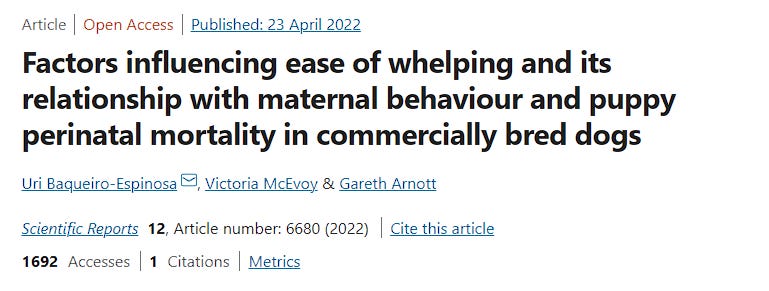
The paper I have picked for this example is one that I am fairly familiar with, as it is not only within my area of interest, but is also relevant to the research I am doing currently (comment below if you’d like a future post on this!!!). As always, this paper is Open Access so that everyone who is reading this blog post can access the paper and follow along if you wish (available here). This paper is essentially looking how a difficult birth for a mother dog is related to her behaviour and the mortality of her pups.
It can be quite tedious to pick out key information from an abstract, and usually difficult to understand how the abstract relates to the study itself. There is a secret, however. Just as research papers are broken into four sections: “Introduction”, “Methods”, “Results”, and “Discussion”, so are abstracts.
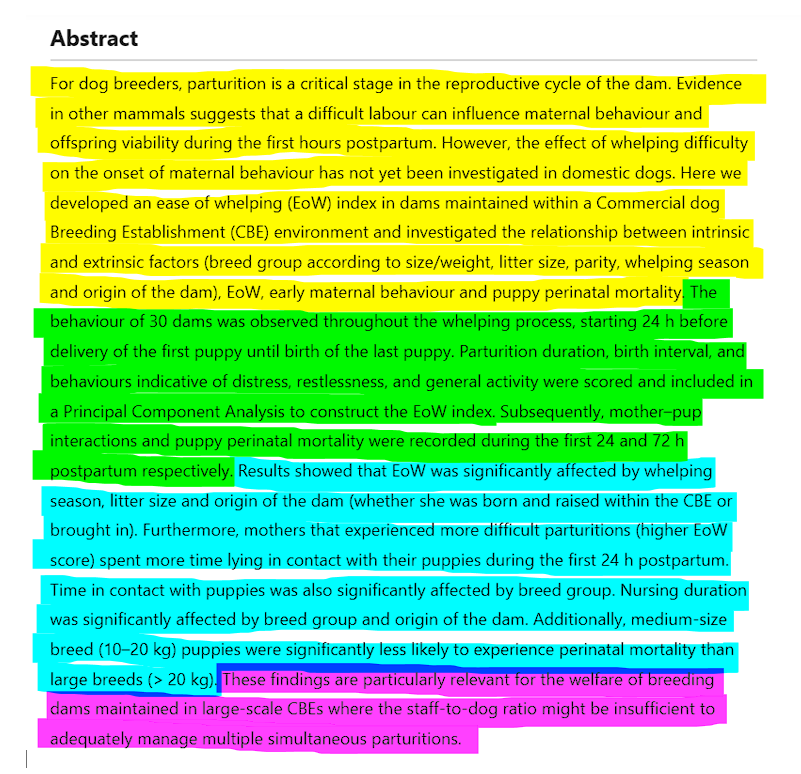
Here, I have highlighted the abstract to show each of these four sections. The yellow highlighting in the “introduction”. The first sentence sets the scene, the next two address the gap in knowledge which this paper is tackling, and justifies the study. The next sentence describes what this study will be doing. In the green is the “methods” section, where the study design is briefly described. In the blue are the “results”, and usually these are the key findings from the study. This is probably the most important part of the abstract to read as it really gives you an idea of what the rest of the paper is about, and if the results align with the introduction and the studies aims/hypotheses. Finally, in the pink is the “discussion” section, which essentially highlights the implications, or the main take-away, from the study.
And it’s just as simple as that! I identify the four sections, highlight each, and then summarise each section. For me, this helps me really break down the paper, before I even read it in depth, and helps me focus on the important aspects of the study.
Let me know if you thought this was useful in the comments below, and if you enjoyed this sort of thing! Like I mention above, if you guys would be interested in hearing about the research I am doing, I’d be happy to write about that here too!
Thank you all again if you made it this far! That is all I have for now, be sure to subscribe to my blog and check back weekly for posts.
Have a great week!
B.
If you guys like this type of content, be sure to drop me a like or a comment to let me know!